Research education built for Somalia.
Somavoice closes the gap in research training that most Somali university programmes assume but never provide.
Equipping undergraduate and postgraduate scholars with methodology, scholarly writing, and publication capacity.
A structural gap, not a student gap.
Across Somali universities, students reach graduation without formal grounding in research methodology, source evaluation, or scholarly communication. These skills are assumed — not taught.
This is not a problem of ability. Somali students are fully capable of producing rigorous work. They simply are not given the structured training to do it. Somavoice exists to provide exactly that.
Output-first. Context-built.
Every Somavoice course ends with a student having produced real work — not a certificate, but a completed literature review, an essay, or a professional document they can use.
Our courses are designed for the realities of Somali universities: the academic conventions students encounter, the source access constraints they face, and the multilingual environments in which most Somali scholars work.
What we stand for.
The academic benchmarks that govern our curricula, cohorts, and institutional delivery.
Rigour
High scholarly standards, because the point of research training is competence that actually transfers.
Relevance
Built for the Somali academic context — not adapted from curricula designed elsewhere.
Practicality
Every course produces tangible, usable output. Students leave with work, not just knowledge.
Integrity
Academic integrity — including in the era of AI-assisted research — is embedded in everything we teach.
Accessibility
Designed for students with limited library access, mixed connectivity, and multilingual backgrounds.
Impact
Measured by the quality of student work and its effect on their academic trajectories.
The people building this.
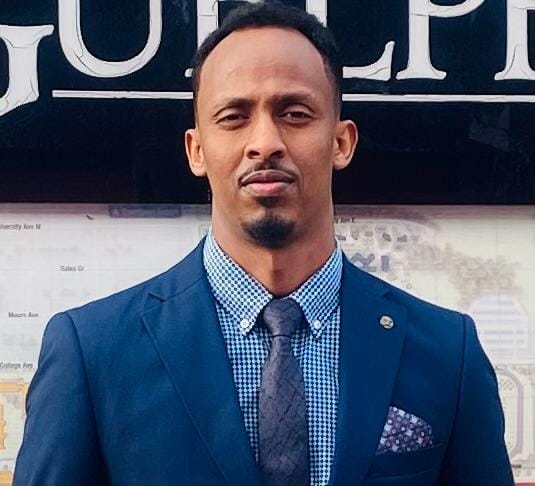
Gorad Muhumed
Founder & DirectorUSIU-Africa (MBA)
University of Guelph (BA)
"Founded from personal experience, not just professional observation."
Gorad was himself a Student Refugee Program (SRP) scholar — one of the thousands of young people who arrive in a new education system with talent and determination, but without the structured research and academic writing training most programmes assume students already have. He felt that gap firsthand before he ever set out to close it for others.
His path since has moved between classrooms, field research, and policy tables. He holds a BA in International Development Studies from the University of Guelph, an MBA from USIU-Africa, and is currently completing an MSc in Digital Education at the University of Edinburgh, where his research focuses on what education is for in an era of AI and rapid technological change.
That academic grounding sits alongside direct field experience. Gorad has taught Peace Education to displaced students in Kenya's Dadaab refugee camp, and co-authored field research on refugee integration presented to an audience of over 300 policymakers and practitioners through WUSC. He currently serves as Policy and Strategic Development Specialist at Somalia's National Leadership Academy, where he works on institutional reform and public-sector capacity building at the national level.
Across every one of these roles, Gorad kept encountering the same structural failure from different angles: talented students, scholars, and professionals held back not by ability, but by the research and writing skills their institutions assumed they already had. Somavoice exists to close that gap directly, starting with institutions and students who need it the most.
Want to know more?
We welcome enquiries from universities, departments, and development partners.